
Ilia of Gallery Persepolis: <span class="text-color-secondary">four generations of craftsmanship in rugs</span>
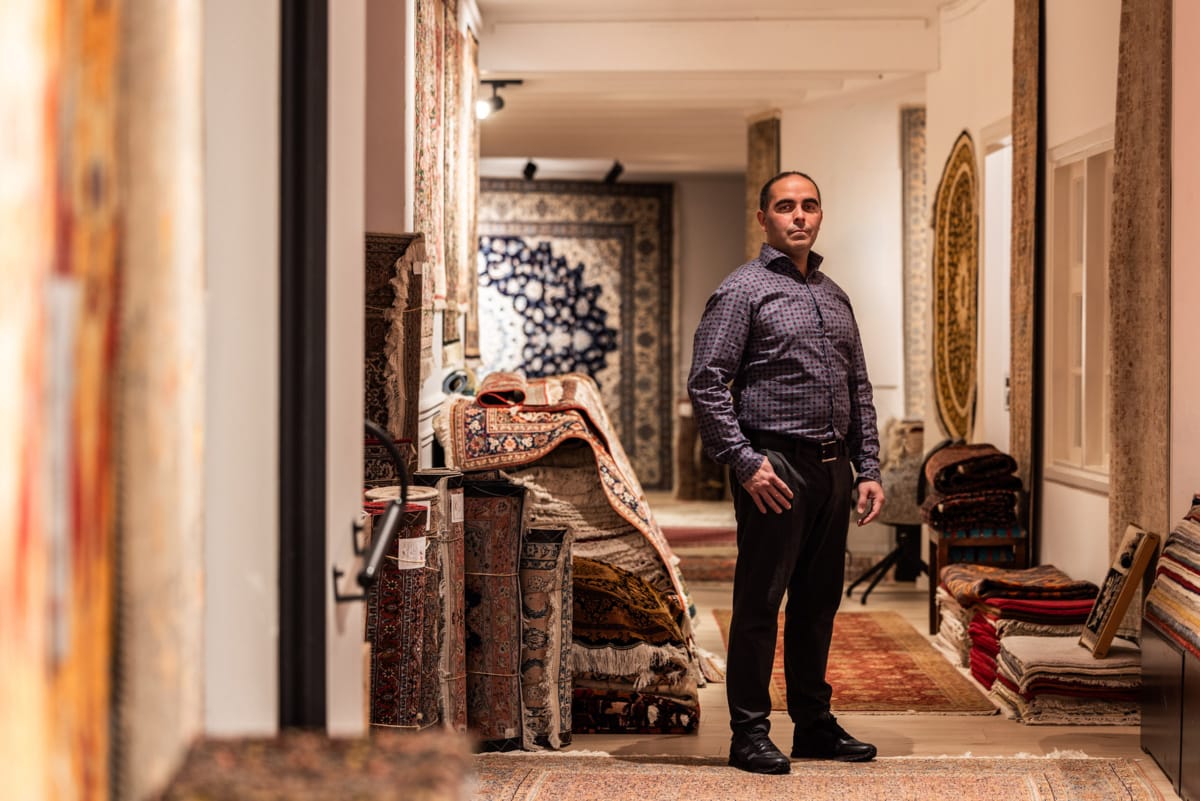
Anyone stepping into the gallery on Sint Pieterstraat sees the rugs first. Hundreds of them, layered one on another, along the walls, rolled up in corners. Only afterwards do you notice Ilia. He is rarely found behind a desk. More often he is crouched beside a freshly delivered fold of wool, fingers on the weave, searching for something only he can feel.
To most people, a rug is an object. To Ilia, it is a document — written in knots and colour, signed by someone whose name he does not know but whose hand he recognises.
A childhood among looms
Ilia was born and raised in Tehran, into a family for whom rugs were not a trade but a matter of course. His parents, his grandparents, and the generations before them earned their living from the same craft: trading, knotting, repairing and cleaning Persian rugs. His childhood unfolded among knotters and dealers, moving from workshop to workshop, in a world where a good rug could outlast a lifetime.
An experienced weaver ties somewhere between eight and twelve thousand knots a day. That sounds like a great many, until you realise that a fine rug can contain more than a million. The arithmetic is simple and unforgiving: months, sometimes years. For the most intricate pieces, as much as six years can pass between design and finished work. Growing up amid that teaches a kind of patience that is never unlearned.
A family that did everything itself
Ilia’s family kept the entire chain in their own hands. Not only the sourcing of rugs, but every step that followed: repair, restoration, cleaning, export, sale. For Ilia, that meant an unforgiving apprenticeship. He skipped no part of it. He has sat beside knotters, worked alongside restorers, and stood behind the counter in family shops. What he can read in a rug today, he could not have learned from a book.
Four generations. It is a phrase easily said and not easily grasped. It means that the people who taught his grandfather to knot were themselves taught by someone whose name is spoken only within the family now. It means that Ilia keeps alive what others have long since lost.
From Iran to Europe
Around 1985, the family shifted its base of work. Europe had suddenly opened up, and the craft travelled with them. What began in Iran found a new home in Belgium: a rug gallery of their own in Maasmechelen, for thirty years the centre of what the family did here. It grew slowly but steadily, with a loyal clientele who knew exactly why they kept returning.
But Ilia and his brother Sharam always lived in Maastricht themselves. For decades, they travelled back and forth, crossing a border between work and home. In early 2024, they made a decision that had been waiting for years: they finally brought the gallery home.
A new name in a world city
The move to Maastricht was more than a change of address. It was a recalibration. The gallery’s name changed, the collection expanded with the modern designs that Maasmechelen had lacked, and the gallery gained two adjoining premises on Sint Pieterstraat, a stone’s throw from the Vrijthof. Maastricht is no accidental choice. Over recent decades, the city has developed into an international meeting point for art, design and culture. A hand-knotted gallery of this calibre belongs there.
Today, Gallery Persepolis holds around two thousand rugs. Classic pieces lie alongside modern ones, plain tones beside floral motifs. Wool beside silk. What stands out is that everything in the gallery is hand-knotted — no exceptions.
What drives him
The craft Ilia grew up in is in retreat worldwide. Knotting a Persian rug is, frankly, no longer lucrative enough to draw younger generations. The work is slow, the margins are thin, and the knowledge disappears with every craftsman who retires without an apprentice.

For Ilia, that is no abstract problem. It is a daily concern. He watches workshops close where he once bought. He watches families who did the same work for generations stop, because their children want something different. It makes his work in Maastricht all the more important. What the gallery still brings in is not only beautiful — it grows rarer by the year.
The approach to cleaning and restoration
Under Ilia’s direction, every rug that comes into the gallery for cleaning or restoration is treated using organic methods. No harsh chemicals. The process relies mainly on water, with plant-based aids here and there where the rug calls for them. It is slower than standard cleaning, and more costly, but the result is different: colour, structure and character remain as they were.
A hand-knotted rug is made of natural fibres — shorn wool, silk, cotton — often dyed with plant-based or mineral pigments. A chemical clean does to such a rug what an industrial wash would do to a watercolour. The piece survives it, but loses something irreversibly. That is why, at Persepolis, the work is done by hand, just as the rug itself was made by hand.

The best part
Ask Ilia about the best part of his work and he will not talk about a sale. He will tell you about what comes after. About customers who return years later to have their rug cleaned. About children who grew up on the fabric their parents once bought. About the quiet confirmation that a rug is not only a purchase, but a presence.
A good rug lasts generations. That is not a marketing promise; it is a historical fact, provided it receives the right care. For Ilia, the circle closes when he sees such a piece grow older in a home. The rug he once selected in Iran, that he helped lay carefully into place here, and that now — sometimes decades later — returns for maintenance, carries something of him with it. That he can still witness this is the reward of the work.
An invitation
Gallery Persepolis is open Wednesday through Sunday, no appointment needed. Ilia is rarely found behind a desk. You will find him among the rugs, and you need not know every name to choose one. A good conversation is enough.
Sint Pieterstraat 34, Maastricht.
Recommended posts
Explore other articles and learn more about our latest events, initiatives, carpets and services.


